October 4, 1957 is the 50th anniversary of Sputnik's launch. Francis Hunger, creator of the Sputnik Gazetteer,Germany has helped to organize a variety of international events. You can find information about them here: http://www.hgb-leipzig.de/~francis/irmielin/works/sputnik/_externalmaterial/issue6.pdf
I will be giving a lecture on Sputnik in my Satellite Media class at UC Santa Barbara from 4-5:20pm in Buchanan Hall 1920, which is open to the public. For anyone who wants to celebrate, come to Tupelo Junction restaurant in SB at 6:30pm.
Wednesday, October 3, 2007

Wednesday, July 18, 2007
Montana bound
I flew from Berlin to Montana this week and will be based here, working for the next couple of months, before returning to UCSB for teaching in the fall. The summers here are so beautiful, as you might be able to surmise from this photo of a late night sunset in Missoula. My year at the Institute for Advanced Study in Berlin was very interesting and productive. Our end of the year party was last weekend on July 13th, and many of the fellows showcased their talents by participating in original musical compositions, skits, cooking an enormous feast, and by tearing it up on the dance floor into the early morning hours! I will miss many of the fellows and staff at the wissenschaftskolleg, and am grateful to have had this past year of work abroad. I'm glad to be back home, however, and I look forward to making the adjustment here in Montana.
Sunday, July 8, 2007
Budapest Seminar on Media Globalization
I am in Budapest for a media globalization seminar at the Central European University organized by faculty at the University of Amsterdam. There are participants from Poland, Hungary, Bellarusse, Ukraine, Latvia, Estonia, Romania, Russia, Bulgaria, and Indonesia, among others. It has been a fantastic week here and the participants in the seminar are amazing. We have been discussing post-communism, national identity, media and memory, the expansion of Europe and the EU, and a variety of other topics. We are creating a blog so that participants can post their thoughts and ideas about media research in central and eastern Europe. Here is the url: www.ceumediastudies.blogspot.com
Thursday, June 28, 2007
Walking Wireless Workers Installation opens in Ulaanbaatar
On June 26 my walking wireless workers installation opened at the Intersections 3 exhibiton in Ulaanbaatar, Mongolia. The project involved four white phone workers situated at four points in a circle facing outward ready to place calls. To activate the installation I called each of the phones from Berlin, highlighting the integration of the white phones within the global wireless infrastructure and economy. Then I called my translator, Zaya, who was located on site at the installation. He projected my voice on a speakerphone and translated my project introduction into Mongolian before a live audience. I paid each of the white phone operators for 2 hours worth of calls (12,000 tgs) and invited visitors of the installation to use the phones for free and help spread information about the arts and Intersections 3 into the wireless bandwidth. Visitors also had access to a handout about my research project and a web interface where they could view photographs of white phone workers that I shot while conducting research in Ulaanbaatar in 2004 and 2007. They also had the opportunity to ask the white phone operators questions about their work and lives.
Zaya and Ochir, curator of Intersections 3, indicated there was great interest in the installation, particularly among the Mongolians who see these white phone workers each day, but rarely stop to think about their work, lives, use of technology, and participation in the economy. Photos and more info will be posted soon, I hope!
Zaya and Ochir, curator of Intersections 3, indicated there was great interest in the installation, particularly among the Mongolians who see these white phone workers each day, but rarely stop to think about their work, lives, use of technology, and participation in the economy. Photos and more info will be posted soon, I hope!
Saturday, June 23, 2007
Upcoming Events
On June 26-28th, my White Phone Workers installation will appear as part of the Intersections 3 international art exhibition in Ulaanbaatar. Thanks to Zaya and Ochir for helping to make this happen.
On July 2, I will give a lecture at Humboldt University in Berlin.
From July 4-9 I will be in Budapest at Central European University teaching a graduate student workshop on Media Globalization together with other colleagues from Europe and the US. My students will be doing a field exercise about media in urban space and I am very much looking forward to this! There is more information about the workshop here:
www.sun.ceu.hu/3Courses/descriptions/Media-2007-detailed.pdf
I put some photos of the Naran Satellite Station and White Phone Workers on my flickr site for those who might best interested. www.flickr.com/photos/cosmowink
On July 2, I will give a lecture at Humboldt University in Berlin.
From July 4-9 I will be in Budapest at Central European University teaching a graduate student workshop on Media Globalization together with other colleagues from Europe and the US. My students will be doing a field exercise about media in urban space and I am very much looking forward to this! There is more information about the workshop here:
www.sun.ceu.hu/3Courses/descriptions/Media-2007-detailed.pdf
I put some photos of the Naran Satellite Station and White Phone Workers on my flickr site for those who might best interested. www.flickr.com/photos/cosmowink
Monday, June 18, 2007
Back in Berlin; Upcoming Lecture and Art Exhibition
I have arrived back in Berlin and my trip to Mongolia was more productive than I ever imagined it could be. I am now preparing for my Einstein Forum lecture in Potsdam on Wednesday, June 20th at 7pm. I will talk about my Mixed Signals book project and focus on my research on Mongolian white phone workers.
Just before I left Ulaanbaatar, I met with an artist and curator, Ochir, who invited me to participate from afar in an international art exhibition later this month in Ulaanbaatar called Intersections 3. We had met and discussed this research a few years ago and he told me he really wanted to include this installation in his upcoming show. So now I am scrambling and coordinating with people in Ulaanbaatar to do an installation piece on June 26th about the white phone workers and I am providing a draft description of the installation concept below.
White Phone Workers Installation
As wireless telephony industry boomed around the world throughout the late 1990s and early 2000s an innovative practice of public wireless telephony emerged in Ulaaanbaatar. In 2001 Mobicom and Mongol Telecom began selling CDMA wireless phones to families who were out of range of landline service. Some of these customers began developing their own business enterprises by selling time on their phones to other citizens and charging 100 tg per minute, twice as much as their own per minute fee. Now there are 15,000-17,000 white phone workers on the streets of Ulaanbaatar selling wireless phone calls to passersby. They work day and night, summer and winter and some earn supplemental income by selling cigarettes, gum and coffee as well.
The “White Phone Workers” installation is designed to draw attention to this new labor force within the telecom sector. Many of these workers migrated to Ulaanbaatar after the economic collapse of the 1990s and have used this as transitional work as their careers and livelihoods have shifted with the change from a communist to a capitalist economic system. The installation is comprised of four white phone workers, situated in a circle, all of whom have unique life stories. Visitors are invited to place phone calls and ask the workers questions about their jobs and lives. Visitors can also view some of Parks’ photographs online at www.flickr.com/photos/cosmowink/sets/72157600378397472/.
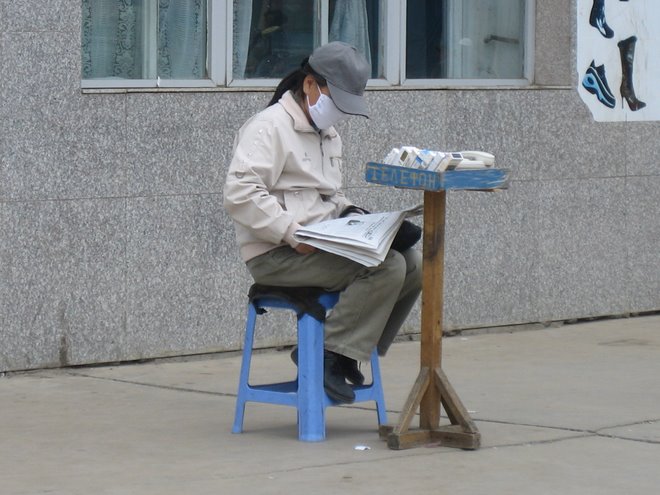
The installation is designed to encourage visitors to consider the transitional and flexible labor practices that have emerged with the development of new telecom and information technologies in Mongolia. Some white phone workers were previously employed as herders in the countryside, tractor operators, construction workers, teachers, or café owners, among other careers. Now they work an average of 8-10 hours a day sitting on the street, often wearing surgical masks to protect themselves from pollution and communicable diseases, and their income is based upon fluctuating traffic flows and demand for wireless phone access. As more and more Mongolians are able to purchase their own wireless phones, it is possible that white phone work may disappear, and many of these workers will be displaced yet again.
This installation is based upon research conducted in Ulaanbaatar in 2004 and 2007, and is related to a book in progress entitled Mixed Signals: Media Technologies and Cultural Geographies being written while Parks is a research fellow at the Wissenschaftskolleg (Institute for Advanced Study) of Berlin in 2006/2007.
Just before I left Ulaanbaatar, I met with an artist and curator, Ochir, who invited me to participate from afar in an international art exhibition later this month in Ulaanbaatar called Intersections 3. We had met and discussed this research a few years ago and he told me he really wanted to include this installation in his upcoming show. So now I am scrambling and coordinating with people in Ulaanbaatar to do an installation piece on June 26th about the white phone workers and I am providing a draft description of the installation concept below.
White Phone Workers Installation
As wireless telephony industry boomed around the world throughout the late 1990s and early 2000s an innovative practice of public wireless telephony emerged in Ulaaanbaatar. In 2001 Mobicom and Mongol Telecom began selling CDMA wireless phones to families who were out of range of landline service. Some of these customers began developing their own business enterprises by selling time on their phones to other citizens and charging 100 tg per minute, twice as much as their own per minute fee. Now there are 15,000-17,000 white phone workers on the streets of Ulaanbaatar selling wireless phone calls to passersby. They work day and night, summer and winter and some earn supplemental income by selling cigarettes, gum and coffee as well.
The “White Phone Workers” installation is designed to draw attention to this new labor force within the telecom sector. Many of these workers migrated to Ulaanbaatar after the economic collapse of the 1990s and have used this as transitional work as their careers and livelihoods have shifted with the change from a communist to a capitalist economic system. The installation is comprised of four white phone workers, situated in a circle, all of whom have unique life stories. Visitors are invited to place phone calls and ask the workers questions about their jobs and lives. Visitors can also view some of Parks’ photographs online at www.flickr.com/photos/cosmowink/sets/72157600378397472/.
The installation is designed to encourage visitors to consider the transitional and flexible labor practices that have emerged with the development of new telecom and information technologies in Mongolia. Some white phone workers were previously employed as herders in the countryside, tractor operators, construction workers, teachers, or café owners, among other careers. Now they work an average of 8-10 hours a day sitting on the street, often wearing surgical masks to protect themselves from pollution and communicable diseases, and their income is based upon fluctuating traffic flows and demand for wireless phone access. As more and more Mongolians are able to purchase their own wireless phones, it is possible that white phone work may disappear, and many of these workers will be displaced yet again.
This installation is based upon research conducted in Ulaanbaatar in 2004 and 2007, and is related to a book in progress entitled Mixed Signals: Media Technologies and Cultural Geographies being written while Parks is a research fellow at the Wissenschaftskolleg (Institute for Advanced Study) of Berlin in 2006/2007.
Wednesday, June 13, 2007
Two Grandmothers, Two Gers
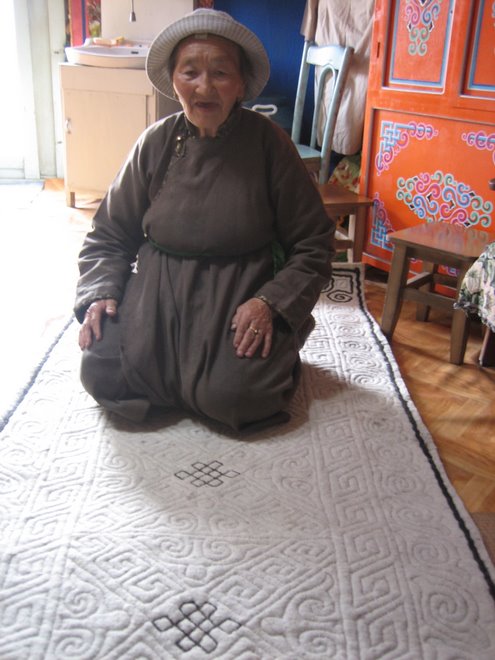
Today I visited a ger settlement to explore how people live in these areas and how television and mobile telephony are integrated within everyday life. I will save this discussion for my book. Here I want to tell a bit about the people I met. One of my friend’s arranged for me to meet with two grandmothers who live in two separate gers on the same lot in a settlement about 15 km out of the center of UB. They are both in their 70s and are vibrant and strong. One of them had nine children, and the other had five. They are originally from the Hovd region in Western Mongolia and one moved to UB 4 years ago and the other moved here last year. I first visited the ger of the grandma who had nine children and she presented me with a table of food and fresh hot milk, which she was heating on the stove in her ger. She was quite a character and was bustling around the ger trying to prepare things for me and her sister who was also visiting that afternoon. I ate fresh hot bread that she prepared on her small stove –everything was delicious! After a while I was invited into the ger of the second grandmother, who also presented me with a table full of food, and this time I had hot dumplings as well, cooked on the stove inside her ger. They were delicious! Her granddaughters and a great granddaughter were also there and I enjoyed meeting all of them. In each of the gers, the grandmothers put on their formal national dresses and we took photos. I will put them on my flickr website soon. When I went back into the ger of the first grandmother, she presented me with a large wool rug that she hand-made out of sheep’s wool, camel hair and yak hair. It took her 25 days to make and it is absolutely beautiful. I was so honored and asked her many questions about how she made it. She also proudly showed me the small needle that she made it with. I was almost in tears by the end of my visit because both of the grandmothers were so warm and generous, They reminded me of my own grandmothers who passed away in recent years, and whom I miss very much! Maybe they were watching this scene and winking from above! Before I left, I gave my silver Mexican bracelet to the grandma who made the rug. She had noticed it on my wrist and commented on it when I first arrived. She had a similar one on her wrist made of Mongolian silver that she hasn’t taken off for 20 years.
Subscribe to:
Posts (Atom)

Around the Antenna Tree: The Politics of Infrastructural Visibility

see my Flow column by clicking on the image
New Book

This book has just been published. An expanded version of my essay "Obscure Objects of Media Studies" is in it
"When Satellites Fall"

Click on this photo of orbital debris to read my essay posted on Flow

Goodbye Rabbit Ears: Thoughts about the Digital TV Transition

see my Flow column by clicking on the image
Max Greuter's catalogue

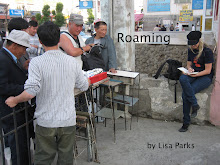
Transmediale Opening - Roaming

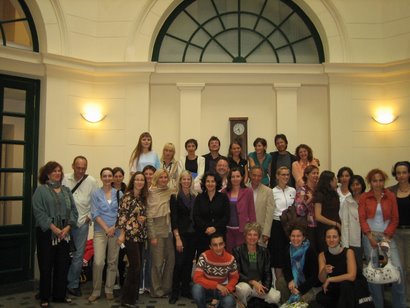
Participants in CEU Seminar
Naran Satellite Station, Mongolia
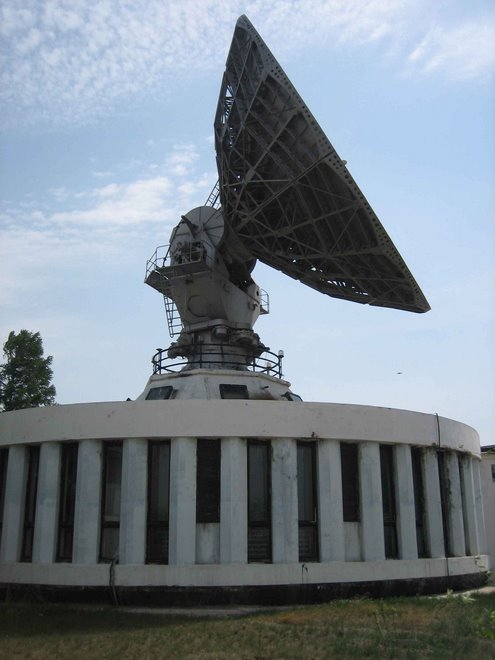
Intersputnik dish
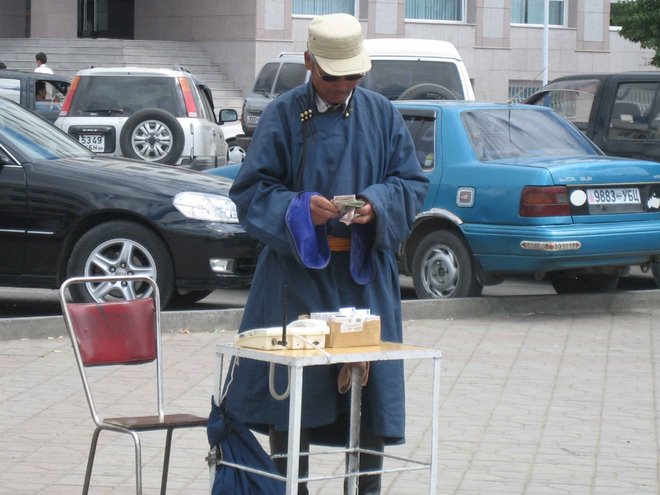
Former herder now a white phone worker
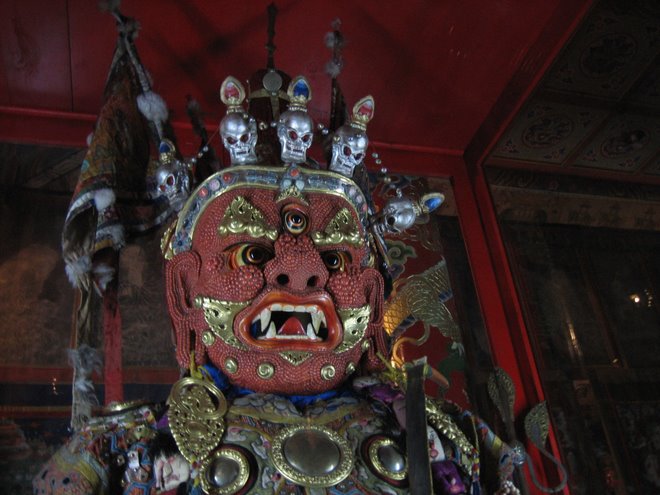
Inside Choijin Lama Temple
Naran's Grandma and the rug she made
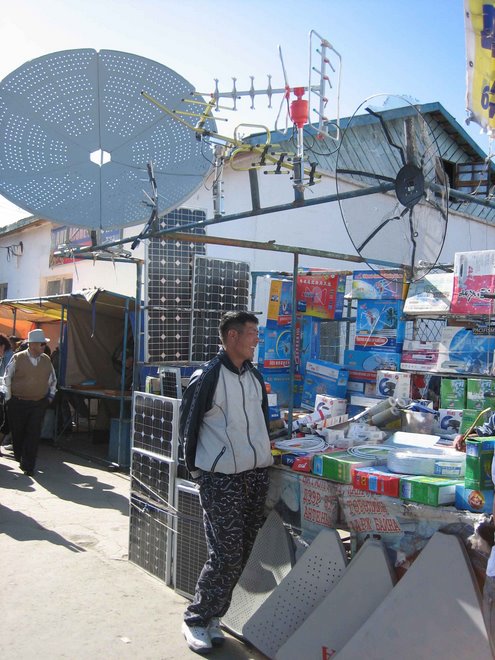
Satellite Dishes and Solar Panels for Sale at Black Market in Ulaanbatar
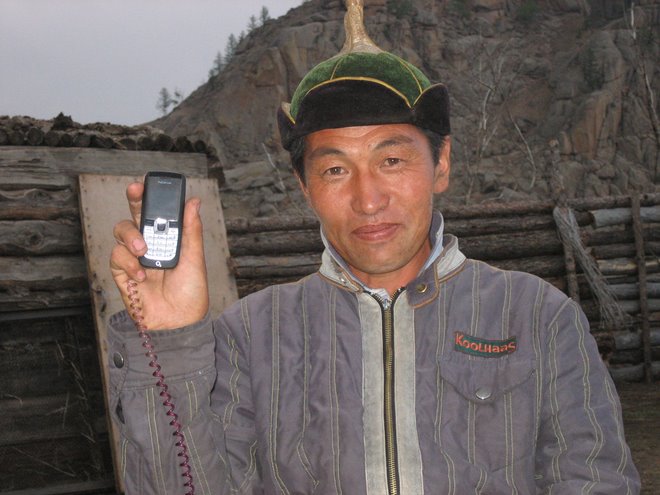
Ponjee and his Nokia phone
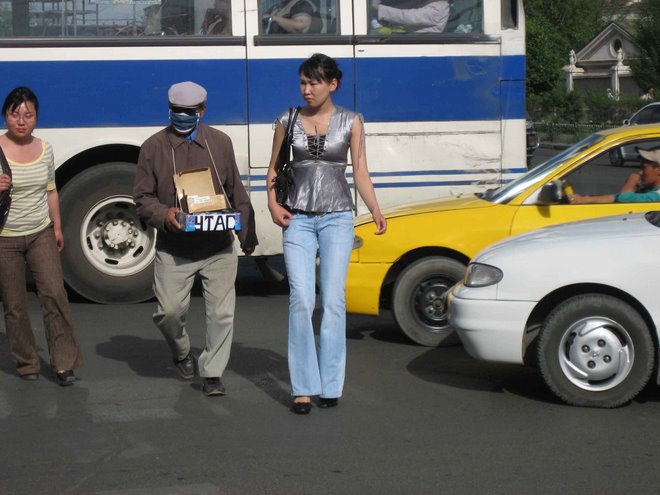
walking phone = yavdag utas
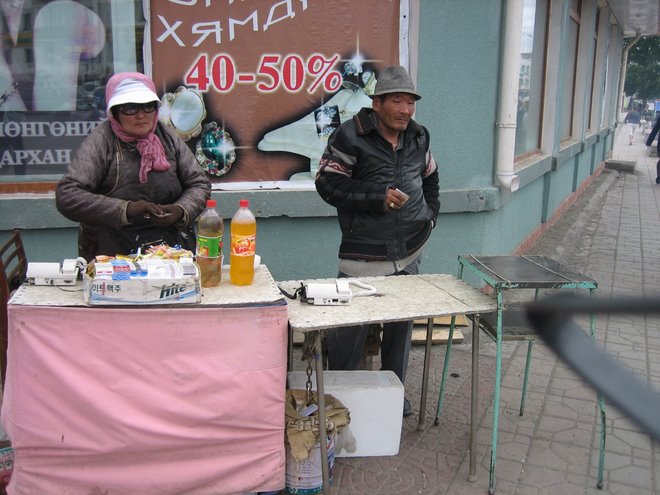
Wireless Phone Workers
Wireless Phone Worker

Satellite Dish and Tool Seller at Black Market